
Indian equity benchmark indices Sensex and Nifty rallied in early trade, driven by reports of a second round of talks between the US and Iran, which are fostering hopes for a resolution to the West Asia conflict, coupled with Brent crude oil prices trading below the USD 100 per barrel mark.
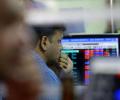
Indian stock market benchmark indices Sensex and Nifty experienced a significant drop in early trade due to rising crude oil prices, bearish global market trends, and continuous foreign fund outflows.

Gautam Adani and Sagar Adani are seeking the dismissal of a US Securities and Exchange Commission (SEC) securities fraud lawsuit, arguing that the case represents an impermissible extraterritorial application of US law and fails for lack of personal jurisdiction.

The Indian rupee depreciated by 32 paise to close at 92.83 against the US dollar, influenced by escalating global tensions, particularly the US-Iran conflict, and the deadline for the RBI's instructions to banks to curb overnight positions.

Indian equity markets experienced a significant downturn, with the Sensex and Nifty plummeting due to rising crude oil prices, geopolitical tensions in West Asia, and continuous foreign fund outflows.
The Enforcement Directorate (ED) reported a decrease in arrests related to money laundering cases but a significant increase in asset seizures during the last financial year. The agency also saw a rise in searches and chargesheets filed.

Indian equity markets experienced a volatile session, with the Sensex and Nifty recovering some ground after a significant plunge the previous day. Gains were driven by PSU bank, IT, and metal stocks, but concerns over rising fuel prices and geopolitical tensions limited the recovery.

Indian stock market indices Sensex and Nifty experienced a significant drop in early trade, reversing a three-day rally. The decline was triggered by a sharp increase in crude oil prices, weak global market trends, and continuous outflows of foreign funds.

The Indian rupee rebounded against the US dollar after the Reserve Bank of India (RBI) restricted banks' net open positions in dollars. This move prompted banks to sell dollars, providing temporary support for the rupee amidst ongoing geopolitical tensions and rising oil prices.

FDI in April, 2007-08 was $1.64 billion which was less than half of the figures in April this fiscal. "I want to dispel fears of any economic slowdown and investment drying up," Commerce and Industry Minister Kamal Nath told reporters in New Delhi on Thursday.
Singh said that a good climate has developed for foreign investors in India.
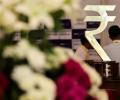
The Indian rupee gained 2 paise to settle at 93.33 against the US dollar, driven by positive sentiment in domestic equity markets and renewed hopes for US-Iran talks, despite rising WPI and CPI inflation.

From the 30-Sensex firms, Trent, Larsen & Toubro, Reliance Industries, InterGlobe Aviation, Maruti, ITC, Adani Ports and Bharat Electronics were among the biggest laggards. In contrast, Eternal, ICICI Bank, Tech Mahindra, State Bank of India and Tata Consultancy Services were among the gainers.

Indian stock market indices Sensex and Nifty closed nearly 1 per cent higher, marking their third consecutive day of gains, supported by a slight decrease in crude oil prices and positive global market trends.

The Indian rupee weakened to a record intra-day low against the US dollar due to a strengthening greenback, continuous foreign capital outflows, and elevated global crude oil prices amidst the West Asia conflict.

FIIs pump in $1.4 billion in March, after pulling out $2.9 billion in Jan-Feb.

'In investing, poor sentiment is always a good vintage to build a portfolio.'

'The challenge in India will be reviving consumption/investment.' 'If the negative surprise in earnings is very sharp or lasts longer than March, it can trigger a sharp sell-off.'
Back after roadshows across the globe, Power Minister Sushilkumar Shinde on Thursday exuded confidence that foreign investors will line up for the government's ambitious ultra mega power projects.

Global financial majors, who until recently viewed India as a safe investment decision, are having second thoughts.

From the Sensex firms, Bharat Electronics, Mahindra & Mahindra, Titan, NTPC, State Bank of India, Adani Ports, Tata Motors Passenger Vehicles and Bajaj Finserv were among the major laggards. Tata Consultancy Services, ICICI Bank, Infosys and HDFC Bank were among the gainers.
Indian stock market benchmark indices Sensex and Nifty experienced a significant decline, driven by escalating tensions in the Middle East and rising crude oil prices.

Indian stock markets recovered from early losses to close higher, driven by value buying in IT and banking shares and a rebound in the rupee.

'In my entire career, whenever friends, relatives, or associates have sought my counsel, I have told them consistently: Stay away from equities. Buy gold. Place funds in fixed deposits. Acquire some raw land.' 'That is all one genuinely needs to build meaningful, enduring wealth, without the attendant anxiety of equity market participation.'

The tax dept has served notices on about 36 foreign investors.

In its first bi-monthly policy, the RBI, in order to enhance hedging facilities for foreign investors in debt instruments, proposed to allow them to hedge the coupon receipts falling due during the next 12 months.

However, foreign investors have completely shunned the infrastructure sector.
At least 77 per cent of all foreign investors in India make profit and another 8 per cent break even, Minister for Commerce and Industry Kamal Nath said.

Italian football is experiencing a significant crisis following the failure of its clubs in European competitions and the national team's continued absence from the World Cup.

Indian benchmark stock indices Sensex and Nifty rallied for the second consecutive day, closing nearly 1 per cent higher, driven by gains in metal and auto sectors and positive global market trends.
Indian stock market benchmarks Sensex and Nifty rebounded strongly after a two-day decline, driven by falling crude oil prices and positive global cues amid hopes of de-escalation in the Middle East.

This single amendment, unfortunately, overshadows much of the Budget's promise, explains Harsh Roongta.
Benchmark indices Sensex and Nifty experienced a significant decline, falling over 1 per cent due to foreign fund outflows and global uncertainties.

The post-Covid euphoria surrounding direct equity investing has ebbed in 2025. Individual investors have turned net sellers in the domestic equity market, pulling out about 8,461 crore so far this year - a sharp reversal from the record purchases seen in 2024, according to a report by the National Stock Exchange of India (NSE).
Foreing investors have high hopes from India due to an uptick in the economy

Platform-style partnerships between global investors and Indian developers are expected to gain further traction over the next few years. This comes as institutional capital increasingly shifts from one-off asset acquisitions to scalable, long-term strategies.
'The biggest risk to the Indian markets from a 12-18-month view is that the current government does not get re-elected, or loses in a way that is not represented at all in the next central government.'

Rupee slumped 69 paise to an all-time low of 92.18 against the US dollar in early trade on Wednesday, as a sharp spike in crude oil prices amid geopolitical tensions following the escalation of the US-Iran conflict weighed on investor sentiment.

Among Sensex firms, Axis Bank tanked the most by 5.03 per cent. Eternal, HCL Tech, Bajaj Finserv, Tata Steel, UltraTech Cement and Bajaj Finance were also among the laggards. However, Titan, Bharti Airtel, Mahindra & Mahindra and Asian Paints were among the gainers.
Maharashtra Chief Minister Vilasrao Deshmukh emphasised on Thursday job creation potential of foreign investors operating their plants in the state saying his government was equally concerned with employment aspect just as the volume of investment.
